Why a CRM Agency Model Breaks at Scale
Learn why a CRM agency model breaks at scale and how B2B agencies can protect margins with repeatable systems and AI-powered operations.
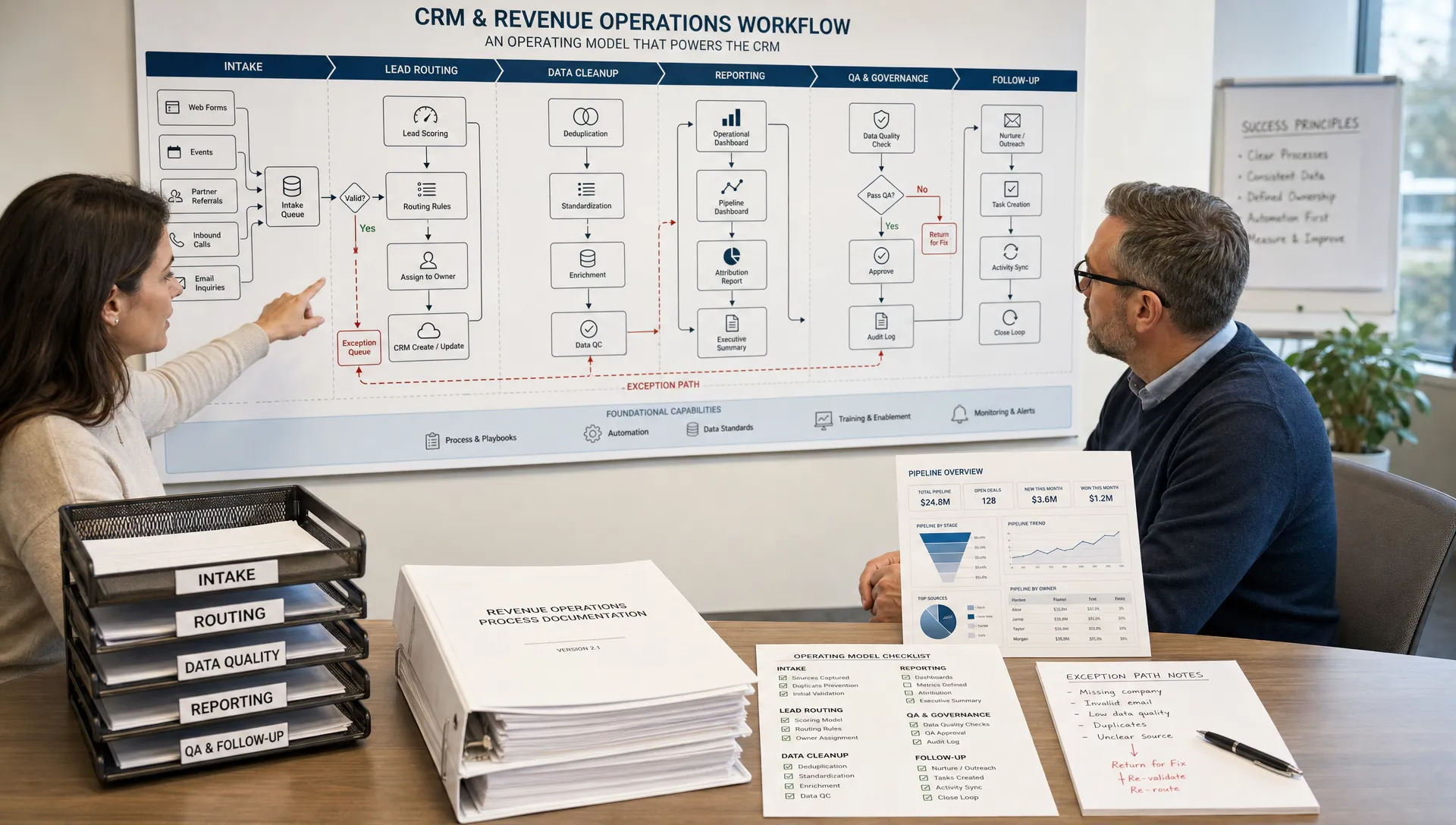
A CRM agency usually does not break because the team lacks CRM expertise. It breaks because the delivery model depends on too much invisible labor.
At five clients, the founder can remember every edge case. At fifteen clients, a senior consultant can still rescue messy data, rebuild a workflow, and explain why a lead-routing rule failed. At thirty clients, the same habits turn into margin leaks: custom implementation paths, manual QA, one-off reporting, unclear ownership, and support requests that never quite become billable work.
The CRM is not the problem. The model around it is.
For B2B marketing agencies, CRM work often starts as a high-value service. It sits close to revenue, clients understand why it matters, and the agency can point to visible outcomes like cleaner pipelines, better follow-up, and improved attribution. But if the agency keeps scaling the service through headcount and heroics, the CRM practice becomes a delivery bottleneck instead of a growth engine.
The hidden promise behind the CRM agency model
Most CRM agencies sell a version of the same promise: “We will make your revenue system easier to run.” That promise is compelling because clients are tired of fragmented tools, inconsistent handoffs, missing data, and sales teams that do not trust the system.
In the early stage, the model works because the agency can absorb complexity. A small team can sit in long discovery calls, interpret messy requirements, build workflows by hand, and keep enough context in Slack threads, spreadsheets, and memory to make the project feel controlled.
The problem is that this model often scales complexity faster than revenue. Every new client adds more than a new implementation. It adds a new set of naming conventions, lifecycle stages, lead sources, sales processes, integration quirks, reporting expectations, and stakeholder preferences.
A CRM agency can charge for implementation, but it often undercharges for entropy.
That entropy shows up in the margins later, when the project is technically “done” but the client still needs fixes, explanations, imports, workflow changes, dashboard edits, and help diagnosing why the system is not being used the way everyone expected.
Why CRM work becomes harder as you scale
CRM delivery is not linear. Adding ten more clients does not simply mean doing the same work ten more times. It means carrying ten more operational realities at once.
A CRM project includes strategic decisions, technical setup, user behavior, data quality, workflow automation, reporting logic, and change management. If each of those areas is handled differently for each client, your delivery team eventually becomes the middleware between the client’s business and the tools they bought.
That is where scale breaks.
Your team is no longer just implementing CRM systems. It is translating vague client requests into process design, cleaning data that should have been governed earlier, manually checking automations, rebuilding reports, answering adoption questions, and fixing downstream issues caused by upstream ambiguity.
The agency may still look busy and successful from the outside. Internally, the signs are obvious: senior people are stuck in QA, account managers are chasing answers from delivery, reporting takes longer than expected, and every “small change” requires someone to remember how the whole system was built.
The seven breaking points of a CRM agency at scale
1. Discovery becomes a custom consulting project every time
Discovery is where many CRM margins are lost before the project begins. If every engagement starts with open-ended interviews and blank-page process mapping, the team has to reinvent the diagnostic layer for each client.
That creates two problems. First, scoping becomes inconsistent because the agency does not always know which edge cases will matter until delivery has started. Second, the client experiences discovery as progress, while the agency experiences it as unpaid complexity.
At scale, discovery needs structure. You still need judgment, but you should not need to invent the questions, artifacts, and decision paths from scratch each time.
2. Data hygiene turns into permanent support debt
Bad CRM data is not a cleanup task. It is usually a symptom of unclear ownership, weak intake, inconsistent field definitions, and workflows that allow incomplete records to move forward.
When an agency handles this manually, the work compounds. Someone exports lists, fixes formatting, merges duplicates, updates properties, and explains why dashboards do not match. Then the same issue reappears next month because the operating system that created the bad data was never changed.
This is where CRM agencies often confuse “client service” with “margin leakage.” Helping a client once is service. Repeatedly fixing preventable data problems is support debt.
3. Automation is built as tasks, not architecture
Most agencies can build a workflow. Fewer agencies have a reusable automation architecture.
A task-based automation model asks, “What does the client want this workflow to do?” An architecture-based model asks, “Where does this workflow fit in the operating system, what data does it depend on, who owns exceptions, and how will we know it is working?”
Without architecture, automations multiply. You get overlapping rules, unclear triggers, brittle dependencies, and automations that nobody wants to touch because one change might break something downstream.
This is especially dangerous for agencies that manage CRM, lead routing, onboarding, reporting, and follow-up. The more connected the system becomes, the more expensive poor structure gets.
4. Reporting becomes a monthly scramble
CRM reporting looks simple until the client asks why the numbers do not match another dashboard. Then your team has to reconcile definitions, lifecycle dates, attribution windows, duplicate records, owner changes, and offline updates.
If reporting depends on a person manually interpreting each client’s setup, every reporting cycle becomes a recurring delivery burden. Worse, it pulls skilled operators away from higher-value work.
This is why agencies need repeatable reporting logic, documented definitions, automated checks, and clear exception handling. The report itself is not the product. Trust in the report is the product.
5. Senior talent becomes the quality-control system
A CRM agency often scales around a few people who “just know how things should work.” They review builds, catch mistakes, remember client context, and rescue projects when a workflow behaves unexpectedly.
That works until those people become the constraint. When senior talent is the QA layer, utilization may look high, but the agency is quietly capping throughput. Every new client increases the demand on the same bottleneck.
The solution is not to remove senior review. It is to stop making senior people compensate for missing systems. Checklists, test protocols, naming conventions, handoff templates, and automation logs should carry more of the quality burden.
6. Client change requests are not operationalized
In CRM work, change requests are inevitable. Sales processes evolve. Lead sources change. Teams reorganize. New campaigns launch. The issue is not that clients ask for changes. The issue is that many agencies lack a structured way to triage, price, implement, test, document, and communicate those changes.
When change requests arrive informally, they create hidden work. A client asks in Slack. An account manager passes it to delivery. Delivery makes a quick edit. Nobody updates the documentation. A month later, someone else cannot explain why the workflow behaves that way.
Scale punishes undocumented kindness.
7. The agency sells CRM, but clients need operating leverage
Clients rarely wake up wanting a better CRM field structure. They want faster follow-up, fewer dropped leads, cleaner reporting, shorter onboarding, better campaign visibility, and less manual admin.
If the agency defines itself only as a CRM implementer, it may get trapped in tool work. If it defines itself as the builder of a revenue operations layer, it can connect CRM improvements to broader business outcomes.
That distinction matters. The CRM is the system of record. It is not always the system of work. Agencies that scale profitably usually build the operational layer around the CRM, including intake, routing, QA, reporting, documentation, and feedback loops.
What breaks first inside the agency
The first thing to break is usually not client satisfaction. It is internal clarity.
Delivery teams start asking the same questions repeatedly. Account managers become translators between client expectations and technical reality. Founders get pulled into escalations. Project timelines stretch, not because the team is lazy, but because the work has too many undocumented dependencies.
Here is a practical way to diagnose where the model is under pressure:
| Breaking point | What it looks like | Margin impact |
|---|---|---|
| Custom discovery | Every kickoff produces a different scope | More senior time before delivery even starts |
| Manual data cleanup | The team repeatedly fixes imports, duplicates, and missing fields | Non-billable support grows quietly |
| Fragile workflows | Small edits create unexpected downstream issues | QA and troubleshooting consume delivery capacity |
| Bespoke reports | Each client has different definitions and dashboard logic | Reporting cycles become labor-heavy |
| Undocumented changes | Slack requests become permanent system behavior | Future work slows because context is missing |
| Senior bottlenecks | Experienced people review or rescue every project | Hiring does not increase throughput proportionally |
None of these issues are solved by “working harder.” They are solved by changing the operating model.

The real constraint is not the CRM, it is the agency operating system
A scaled CRM agency needs more than platform expertise. It needs an agency operating system that turns repeatable work into controlled workflows.
That system should answer questions like:
- What information is required before a CRM build starts?
- Which decisions are standardized, and which are client-specific?
- How are workflow changes tested before they go live?
- Where are field definitions, lifecycle stages, and automation rules documented?
- What reporting checks happen before a client sees a dashboard?
- Which requests are included, and which become paid change orders?
If those answers live in people’s heads, the agency cannot scale cleanly. If they live in templates, automations, QA gates, and documented delivery paths, the agency can grow without turning every new client into a new operational invention.
This is the same reason broader agency marketing systems that protect your margin matter. CRM delivery is only one part of the machine, but it touches almost every margin-sensitive workflow: onboarding, research, campaign handoffs, reporting, and client communication.
Why AI makes the old CRM agency model more fragile
AI does not eliminate the need for CRM expertise. It raises the bar for operational discipline.
Clients now expect faster turnarounds, cleaner documentation, more proactive insights, and less manual reporting. At the same time, agency teams are experimenting with AI for research, content, analytics, and client service. That creates opportunity, but only if the agency has a process layer strong enough to absorb it.
Using AI inside a messy CRM delivery model can make the mess faster. It can generate documentation for workflows nobody has validated. It can summarize data that is not clean. It can accelerate reporting without resolving definition problems. It can create more outputs while the underlying system remains fragile.
Used properly, AI should reduce operational drag. It can help standardize intake, summarize client context, draft SOPs, flag missing data, support QA, prepare reporting narratives, and speed up research. For teams building their AI literacy, practical resource libraries like AIMarketer Hub can be useful for exploring AI marketing workflows, prompts, and tool ideas before deciding what belongs in a production process.
The key is sequence. Do not bolt AI onto chaos. First define the workflow. Then automate the repeatable parts. Then use AI to improve speed, consistency, and decision support.
The shift: from CRM implementation to AI-powered operations
A more scalable CRM agency model does not abandon CRM work. It reframes it.
Instead of selling “we configure your CRM,” the agency moves toward “we install and improve the operating layer around your revenue workflows.” That shift changes how delivery is packaged, scoped, and managed.
A CRM implementation might include fields, pipelines, automations, integrations, and dashboards. An AI-powered operations model includes those things, but also adds structured intake, standardized QA, automated follow-up, documentation, reporting narratives, and workflows that reduce manual agency labor.
The difference is leverage.
| Old CRM agency model | Scalable operations model |
|---|---|
| Starts with open-ended discovery | Starts with a structured diagnostic |
| Builds workflows client by client | Uses reusable patterns with controlled customization |
| Relies on senior review | Uses QA gates, logs, and documented standards |
| Treats reporting as a deliverable | Treats reporting as a trust system with definitions and checks |
| Handles support reactively | Routes requests through triage and change control |
| Adds headcount to grow | Adds systems before headcount |
This is where agencies should be careful about what they automate first. Flashy AI content generation may look exciting, but the highest-margin gains often come from operational workflows that happen every week. If you need a practical prioritization lens, start with what a marketing agency should automate first before adding more tools to the stack.
How to rebuild the model before it breaks
The goal is not to make every client identical. The goal is to make the agency’s delivery path consistent enough that customization does not destroy margin.
Start with the workflows that create the most repeated effort. For a CRM agency, that usually means intake, data validation, lifecycle definitions, lead routing, reporting, documentation, and change requests.
Then create a standard operating layer around each one. That layer does not need to be complicated. It needs to be explicit.
For example, a scalable lead-routing workflow should define required fields, routing logic, exception paths, owner notification rules, follow-up timing, audit logs, and reporting outputs. A scalable reporting workflow should define source data, metric definitions, dashboard ownership, QA checks, narrative generation, and the process for handling discrepancies.
The important move is to stop thinking of automation as isolated tasks. Think in systems.
A strong operating layer should include:
- Standardized intake forms that prevent incomplete requirements from reaching delivery
- Reusable workflow patterns for common CRM and revenue operations scenarios
- QA checklists that junior team members can run before senior review
- Automated alerts for missing data, failed handoffs, or stalled follow-up
- Documentation that updates as part of the delivery process, not as an afterthought
- Reporting definitions that are agreed upon before dashboards are built
This is also where AI can help agencies improve delivery without immediately hiring. The right AI ops layer can support research, reporting, CRM hygiene, onboarding, content operations, and follow-up, but it has to be installed around the agency’s actual workflows. For a deeper look at that concept, see why marketing teams increasingly need an AI ops layer instead of more disconnected tools.
The margin question every CRM agency should ask
The most important question is not, “Can we deliver this?”
Most CRM agencies can deliver more than they should. The better question is, “Can we deliver this again without adding the same amount of senior labor?”
If the answer is no, the agency is not scaling. It is accumulating obligations.
A healthy CRM agency model should improve with repetition. The tenth onboarding should be smoother than the first. The twentieth reporting setup should be faster than the fifth. The thirtieth workflow change should be easier to price, test, document, and deploy.
If repetition is not creating leverage, the agency lacks a system.
Frequently Asked Questions
Why does a CRM agency model break at scale? It breaks when delivery depends on custom processes, manual QA, senior-person memory, reactive support, and undocumented client-specific decisions. The CRM may work, but the agency’s operating model becomes too labor-intensive to scale profitably.
Is CRM implementation still a good service for B2B agencies? Yes, CRM implementation can be valuable, especially when tied to revenue outcomes like faster follow-up, cleaner attribution, and better pipeline visibility. The challenge is packaging and delivering it through repeatable systems rather than one-off consulting labor.
What should a CRM agency automate first? Start with workflows that create repeated internal effort, such as client intake, data validation, lead routing, reporting QA, documentation, and change-request triage. These areas usually protect margin faster than automating client-facing content alone.
How does AI change CRM agency delivery? AI can help summarize requirements, draft documentation, support reporting narratives, flag data issues, and speed up research. But it should sit on top of a clear workflow. If the underlying process is messy, AI may simply make the mess move faster.
What is the difference between a CRM system and an AI ops layer? A CRM system stores and organizes customer and pipeline data. An AI ops layer helps manage the repeatable work around that system, including intake, follow-up, reporting, QA, documentation, and workflow automation.
Build the operating layer before you hire around the bottleneck
If your CRM agency is growing but margins feel tighter, the answer may not be another hire. It may be a better operating layer.
Archer Scaling AI helps B2B marketing agencies install and run AI-powered operations systems that improve delivery margin across workflows like CRM, onboarding, reporting, research, follow-up, and content operations. The engagement starts with a paid Margin Teardown that identifies the roadmap and three automation moves, with a risk-reversed structure.
If you want to see what an AI ops layer could remove from your delivery load, start with Archer Scaling AI and look at the system before you commit.